


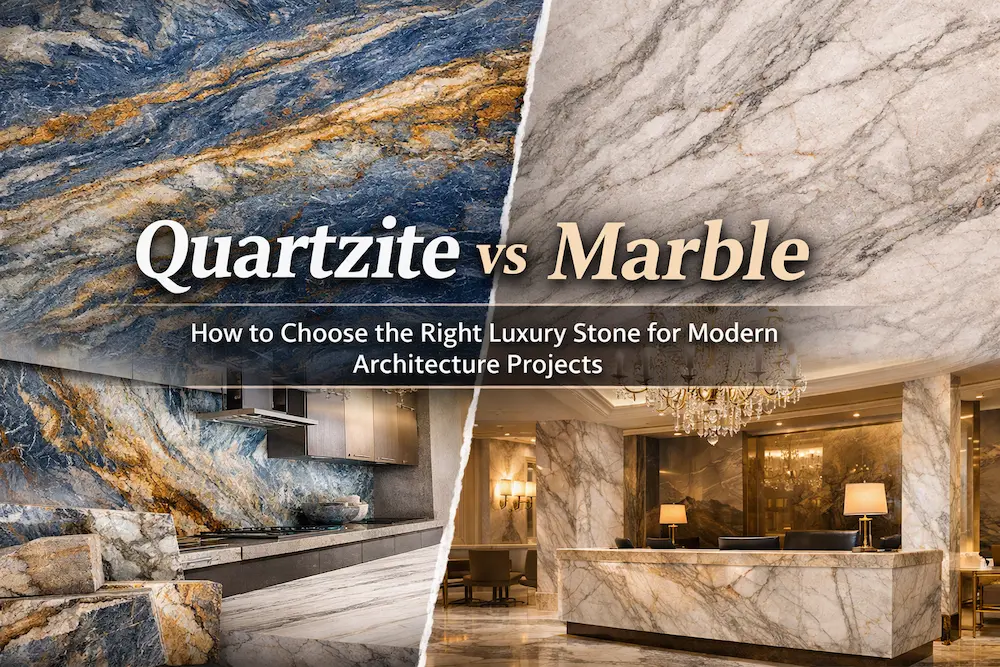
“We want something luxurious, but it must survive a 10-year commercial lease.”
That short briefing often defines the procurement conversation between architects, developers, and vendors. The core decision reduces to one practical comparison: quartzite versus marble. Each stone category brings its own strengths and trade-offs, and selecting the right one depends on application, lifecycle expectations, and aesthetic goals.
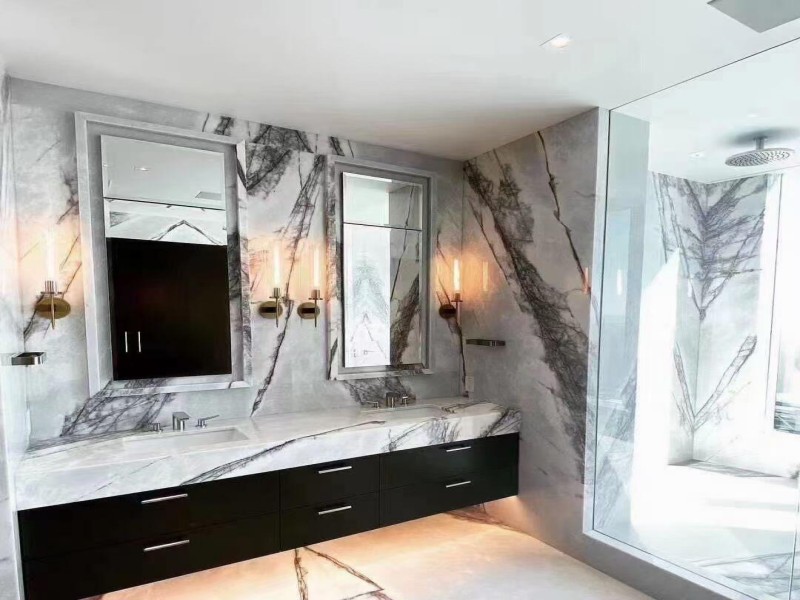
【此图片来源:HRC STONE】
In recent years, design trends have moved toward materials that balance beauty with long-term performance. Developers and asset managers increasingly specify stones that lower operating costs and minimize refurbishment during tenancy turns. Quartzite varieties such as Blue Roma Quartzite and White Macaubas Quartzite are commonly selected for high-contact verticals and countertops due to their enhanced structural properties. These materials reduce lifecycle interventions and often deliver better total cost of ownership across hospitality and commercial assets.
Design teams still choose marble—especially premium Italian marbles like Palissandro Classico Marble—for lobbies, feature walls, and curated environments where visual impact is the dominant criterion. The important point for specifiers is to map the stone choice to the specific performance needs of each project zone.
| Feature | Quartzite | Marble |
|---|---|---|
| Typical Mohs Hardness | ~7 | ~3–4 |
| Scratch Resistance | High | Moderate |
| Heat Resistance | Very Good | Good |
| Porosity | Low | Medium to High |
| Maintenance | Lower frequency | Higher frequency |
These figures are generalizations; individual quarries and finishing processes affect real-world performance. Still, the technical comparison clarifies why quartzite is favored in kitchens, bars, and commercial floors where abrasion, heat exposure, and staining risk are daily realities.
Q1: Is quartzite objectively more durable than marble?
A1: Yes. On objective metrics such as Mohs hardness and abrasion resistance, quartzite outperforms marble. This translates to fewer surface repairs and longer intervals between restorations in high-traffic areas. Contractors report lower incident rates of chipping and etching for installed quartzite surfaces under comparable use conditions.
Q2: When is marble still the right choice?
A2: Marble is preferable when vertical surfaces, decorative panels, and low-impact areas are primary. Its veining and color depth create visual narratives that many luxury brands and hospitality projects deliberately seek. For boutique hotels and curated retail, marble often contributes directly to perceived brand value.
Q3: Can proper specification mitigate marble’s weaknesses?
A3: Absolutely. Correct substrate preparation, sealants, edge details, and maintenance schedules reduce risk. Specifying thicker slabs, protective detailing around service zones, and scheduled professional maintenance dramatically extends marble’s useful life in semi-exposed settings.
Blue Roma Quartzite—dramatic blues and golds make it an ideal feature-wall stone. Its mineral structure provides visual depth while maintaining robustness for public-facing vertical installations.
White Macaubas Quartzite—a softer tonal quartzite favored for minimalist kitchens. Its resistance to heat and common kitchen abrasions explains its popularity among chefs and residential clients.
Patagonia Quartzite—known for its crystalline patterns and translucency. Often used in reception desks and sculptural countertops where backlighting or bookmatching enhances the aesthetic.
Taj Mahal Quartzite—neutral, warm, and structurally stable; a workhorse for countertops that require both subtlety and performance.
Palissandro Classico Marble—an Italian marble chosen for lobbies, curated retail, and executive boardrooms. Its layered veining reads as craftsmanship and timeless luxury.
Below is a practical matrix developed from HRC STONE project experience and installer feedback. It reflects common outcomes across residential and commercial projects and is designed for rapid decision-making during the specification phase.
| Space | Recommended Stone | Why |
|---|---|---|
| Kitchen Countertops | Taj Mahal / White Macaubas | Heat and scratch resistance with neutral aesthetics |
| Feature Walls | Blue Roma / Patagonia | High visual impact and bookmatching potential |
| Hotel Lobby | Palissandro Classico Marble | Artistic veining and perceived value |
| Commercial Flooring | Quartzite | Durability and low lifecycle maintenance |
Initial acquisition cost is only part of the equation. Owners must plan for cleaning cycles, potential resealing, and repair windows. Quartzite usually requires less frequent deep maintenance, which can translate into lower total cost of ownership over 5 to 10 years. Conversely, marble can raise perceived property value and may justify higher rental rates when used strategically in brand-defining areas.
When advising clients, HRC STONE recommends a lifecycle budget that includes conservative estimates for polishing and seam repairs, particularly in hospitality and commercial projects where wear is concentrated.
In a recent boutique hotel renovation managed with HRC STONE, designers specified quartzite for public lobbies and marble for curated suites. Over a three-year post-installation review, lobby areas with quartzite reported minimal surface interventions, while marble areas required periodic touch-up polishing to address wear near high-contact points. The combined approach preserved guest experience while optimizing maintenance budgets — a practical demonstration that mixed-material strategies can deliver both durability and brand impact.
Successful installations begin with real-world detailing: use uncoupling membranes where substrate movement is expected, specify appropriate adhesive systems for heavy slabs, and enforce tight seam tolerances to avoid moisture traps. HRC STONE collaborates with installers to provide slab-specific recommendations and pre-installation mock-ups to validate color, veining alignment, and edge details before final assembly.
Contacting your supplier early in the design phase reduces selection errors, ensures slab availability, and secures bookmatched sets. HRC STONE recommends early procurement to align lead times with construction schedules.
Plan ahead; prioritize long-term value.
Quartzite is typically harder and less porous, making it more resistant to scratches and staining. Marble offers more expressive veining and a warmer palette but needs more careful maintenance. In practice, this means that quartzite installations have lower incident rates of surface wear, which is especially important in commercial kitchens, retail environments, and public corridors.
Quartzite is generally safer for busy kitchens due to higher abrasion and heat resistance, though proper sealing and maintenance matter for any natural stone. Operationally, restaurants prefer materials that minimize downtime; quartzite’s resistance to etching and chipping can reduce service interruptions and the need for emergency repairs.
It depends on use and porosity. Many commercial marble installations benefit from annual professional maintenance and resealing every 1–3 years depending on traffic. In high-contact hospitality settings, a proactive maintenance contract that includes periodic cleaning and polishing can preserve finish and prevent deep stains that require material removal.
Yes, in high-visibility applications. Bookmatching creates mirrored veining that elevates perceived value and design coherence in lobbies and feature walls. The premium is often recouped through brand perception and the ability to command higher room rates or retail prices in hospitality and retail scenarios.
HRC STONE implements slab-by-slab inspection, defect mapping, and standardized packing protocols. We recommend clients request slab photos and acceptance reports prior to shipment. Our logistics team also conducts loading checks and provides traceable documentation for each container to ensure slabs arrive in the exact condition described during selection.
Contacting your supplier early in the design phase reduces selection errors, ensures slab availability, and secures bookmatched sets. HRC STONE recommends early procurement to align lead times with construction schedules.